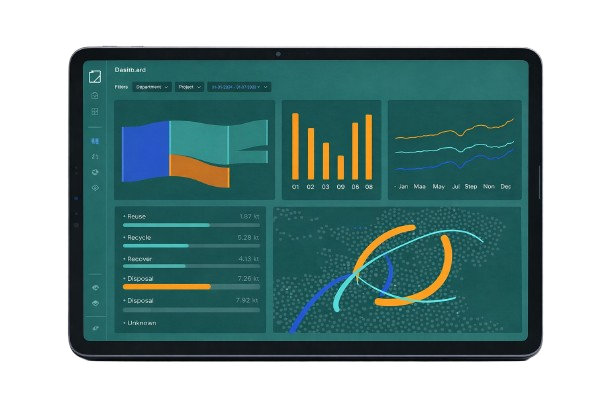
We help you leverage leading waste management software for compliance automation, performance benchmarking and circularity optimisation – while improving your margin
Many companies and governments struggle to gain a clear and complete overview of their waste streams, limiting their ability to improve processing, reduce costs, and meet sustainability targets. With the right data, structure, and guidance in place, these challenges can be turned into actionable opportunities to increase your margins and improve your environmental impact.
New EU rules - like textile EPR - put financial responsibility directly on producers.
Poor sorting and recycling practices increase emissions and societal costs.
Strong waste management directly supports Net Zero, ESG reporting, and CSRD compliance.
Circularity is becoming a key expectation from regulators, investors, and consumers.
How we can help
Key concerns our customers are facing:
Is there logistically a more efficient way to dispose of waste?
How are we doing compared to other companies?
How can I cope with manual processes and increasing legislative pressure?
Circularity optimisation
Performance Benchmarking
Ready-To-Use Software
Our approach
Waste is no longer just an operational challenge.
It is a regulatory, financial, and reputational priority.
Our solution for companies
We implement specialist waste management software to transform your waste streams into circular value - maximising reuse and recycling, reducing costs, and achieving a total project payback period of less than one year
Our solution for governments
We deploy advanced waste analytics software to help municipalities and provinces understand and manage all material and waste streams, providing visibility into processing pathways and identifying opportunities to improve circularity and efficiency.
We support you throughout onboarding with expert guidance and hands-on support to ensure progress and clarity.
Step 1
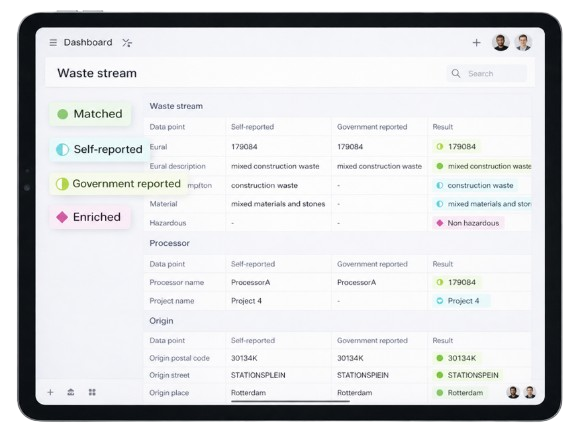
Automate your data processing
Your own waste data (e.g. Invoices)
Governmental data
Use AI to enhance/complete your data
Step 2
Performance insights
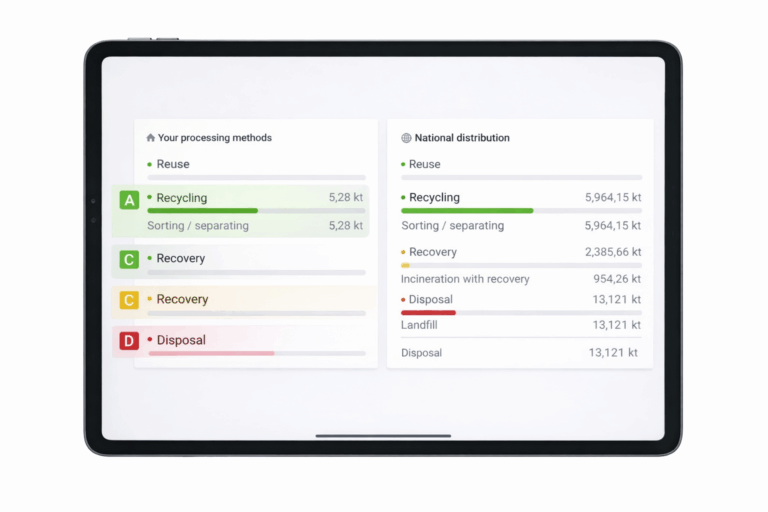
Compare with best in class
Compare with national averages
Best practices for each waste stream
Step 3
Improve your circular performance
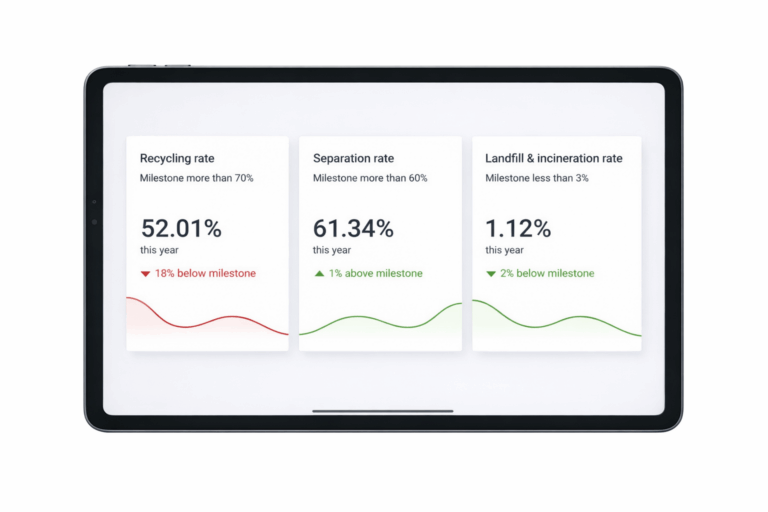
Goal setting and progress management
Optimize travel distances of your waste streams
Find the best processors for your waste
Step 4
Reporting
Automate internal reporting
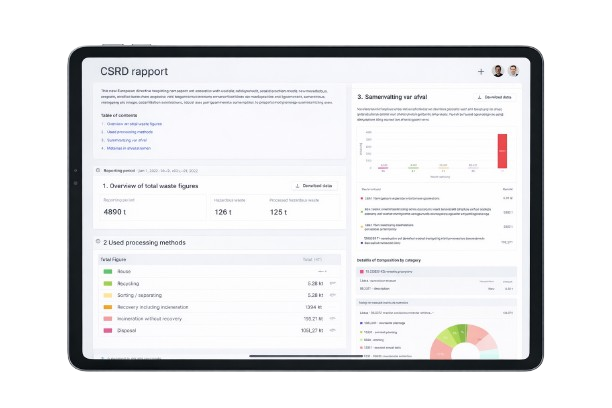
Generate compliance reports (e.g. CSRD E5)
Single waste data repository => aligned reporting
Use cases
Examples of how our Waste solutions can help your business
Automated Compliance & ESG Reporting
Example: For companies facing rising regulatory pressure, needing to deliver accurate, auditable waste data for ESG/CSRD disclosures without manual overhead.
Automates data collection and verification from multiple waste streams
Consolidates all waste-related documents and trips into one platform.
Reduces risk of under-reporting or missing waste streams, ensuring full compliance.
Multi-Site Waste Benchmarking
Example: When a company operates across multiple sites or countries and needs consistent waste-stream oversight, benchmarking performance, and identifying inefficiencies.
Enables comparison of waste-generation, recycling and treatment performance across sites.
Highlights underperforming sites or waste streams, enabling targeted improvement.
Provides transparency over where waste goes — locally, abroad, or to non-reportable processors.
Standardises data collection across jurisdictions for easier internal auditing and reporting.
Circularity & Material Re-Use Optimization
Example: For companies looking to move beyond disposal — to integrate circular economy practices, reuse materials, reduce virgin raw-material use, or divert waste from landfills/incineration.
Identifies which waste streams can be recycled, reused or diverted, helping to close material loops.
Maps waste flows geographically and points to nearest or most sustainable processors
Supports circular procurement decisions by revealing material recovery potential from existing waste.
Enables businesses to reposition waste from cost burden to a resource
Cost & Emission Reduction Through Waste Data
Example: When a company needs to lower disposal costs, reduce waste-transport emissions, and optimise operational efficiency by using data instead of manual spreadsheets.
Cuts waste-data processing and manual reporting time by 70–90%
Detects anomalies & inefficiencies in waste invoices, volumes or transport routes
Optimises waste-transport by recommending closer or more efficient processors, reducing transport-related CO₂ emissions.
Enables better vendor/supplier benchmarking for waste treatment